Umubano Gorilla Family in Volcanoes National Park, Rwanda
Umubano means living together, and the name is a little ironic. The family was born from a rivalry when a young silverback named Charles spent months challenging the leader of the Amahoro group, Ubumwe, and finally left with a number of females to start a family of his own.
Yet the two groups now live in the same area of Mount Bisoke, and sources describe a kind of mutual respect between the two silverbacks. One page, updated in 2026, calls it a peaceful split from Amahoro. For visitors, Umubano is a neat illustration of how gorilla society handles conflict and a good family to hear about from a guide on the way up.
This guide explains the Umubano family and what to expect on a trek. It covers the meaning of the name and the story of the split, the size of the group as sources describe it and the conflicts between them, what the relationship between Umubano and Amahoro looks like, where the family lives and how hard it is to reach, what the hour is like, how to compare it with its neighbors and how allocation works, since you cannot book it in advance. Group details change, so figures are given as ranges and flagged where sources conflict.
Umubano at a Glance
The size range probably reflects different years and different counting methods. A family formed with about 13 members may have lost some and gained others in the years since, and an older group of nine may have grown.
| Fact | Detail |
| Name | “Umubano” means “living together” or “neighborliness” in most sources |
| Origin | Split from the Amahoro family after the silverback Charles challenged its leader, Ubumwe |
| Leader | The silverback Charles |
| Reported size | About 9 to 13 members, with one to three silverbacks |
| Territory | The slopes of Bisoke, in the same area as Amahoro |
| Trek | Not described separately in most sources, and similar to Amahoro, which is relatively strenuous |
| Character | A family formed through rivalry, described as living peacefully beside its parent group |
The Meaning of the Name
“Umubano” is a Kinyarwanda word that most sources translate as “living together” or “neighborliness.” One source translates it as all-inclusive, which seems to be a looser rendering of the same idea. The name was given to the family by those who habituated it and follow it, and it reflects both the group’s cohesion and its relationship with its neighbors.
It is a fitting name for a family that left another family and still lives beside it, and the sense of neighborliness is one of the reasons the family is a favorite with guides who like to tell the story.
The Story of the Split
The Amahoro group was led by Ubumwe, a silverback known for his calm and congenial nature. Another silverback in the group, Charles, grew into a silverback of the same rank as Ubumwe, and according to trackers he refused to take orders and fought the leader for months. Ubumwe’s peaceful nature meant that he did not respond in the way a more aggressive silverback might, and Charles eventually took some of the females and left to form his own family.
Sources say that Charles left with about 13 members and that he persuaded about twelve like-minded gorillas to join him in a family that one source describes as believing in other ways of solving problems apart from violence. That characterization is a human interpretation, but it fits the pattern of a split that did not end in serious injury, and the resulting families coexisted.
Rivalry and Reconciliation:
In gorilla society, rivalry between groups is common, and encounters between silverbacks can range from displays and chest-beating to fights. Over time, neighboring groups can settle into a pattern of tolerance, particularly when the leaders know each other and when the split that created them did not end in lasting injury.
The sources describe Charles as having gone on to command respect and recognition from Ubumwe. That suggests a relationship in which the two leaders have settled their differences and live side by side. For visitors, it is a reminder that gorilla families are not isolated units but members of a neighborhood and that relationships between groups can change over time.
Size and Composition:
Published sizes for Umubano vary. One source gives 13 members, including two silverbacks; another gives 11 individuals with six youngsters; another gives nine individuals with one silverback; and one gives 12 members, including three silverbacks, three blackbacks, two females, three juveniles and one baby. A description from a 2025 listing gives 13 individuals with one silverback, a blackback, six infants and three adult females.
These figures cannot all describe the same moment. The family may have lost and gained members, and different sources may count silverbacks and blackbacks differently. What is consistent is that Umubano is a small to medium family, with a leader named Charles and, in several accounts, a good number of infants and juveniles. Ask your guide on the day for the current composition.
Territory and the Trek
Umubano lives on the slopes of Mount Bisoke, close to the Amahoro family, which shares its territory. Bisoke is one of the Virunga volcanoes, with a crater lake at its summit, and the slopes are steep, forested and often muddy. Sources describe the trek to Amahoro as relatively strenuous, with a steep slope to climb, and there is no reason to assume that Umubano is easier.
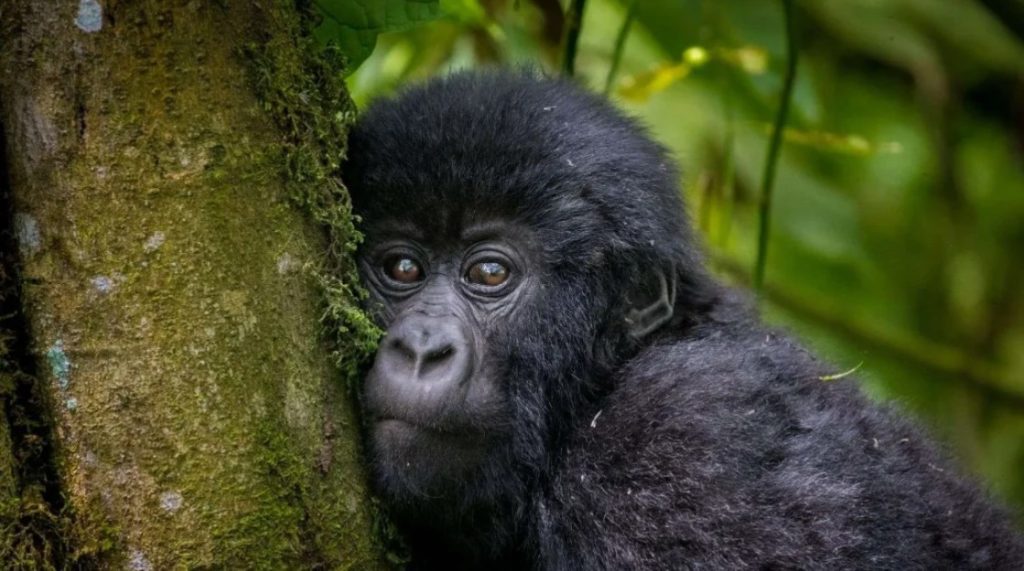
Plan for a moderate to demanding trek. The ground can be slippery in the rainy seasons, the altitude is high and the weather changes quickly. A porter, waterproof boots and gaiters make a real difference, and an honest word about your fitness at the briefing helps the rangers match you to a family. Treat any claim about an easy trek with caution.
What the Hour With Umubano Is Like
Many visitors enjoy the stories more than they expect. A guide who tells the Umubano and Amahoro tale makes the hour feel like part of a longer drama, and watching the animals with that in mind gives it extra depth.
- A small to medium family, in which you can follow individuals and watch relationships.
- A silverback with a story, since Charles left a family to build one of his own.
- Infants and juveniles in most accounts, with sources mentioning six infants in some descriptions.
- The possibility of hearing or glimpsing the neighboring Amahoro family, which shares the area.
- The usual one hour, with a minimum distance of about 7 meters where possible and a strict ban on flash and food.
Umubano and Amahoro: A Pair to Compare
If you trek one, ask your guide to tell you about the other. Hearing both sides of the story is part of the pleasure, and the families’ closeness means that you are often walking through the territory of both.
| Feature | Umubano | Amahoro |
| Name | Living together or neighborliness | Peace |
| Leader | Charles | Ubumwe |
| Origin | Split from Amahoro | The parent group |
| Reported size | About 9 to 13 | About 12 to 18 |
| Territory | Bisoke slopes, near Amahoro | Bisoke slopes |
| Character | A group formed through rivalry | The most peaceful group in the park |
| Trek | Similar to Amahoro, moderate to demanding | Relatively strenuous |
A Peaceful Split Is Still a Split
It would be easy to read the Umubano story as a neat tale of conflict and resolution, but it is worth remembering that the split cost the Amahoro group members and that the months of challenge were stressful for both silverbacks. A family that loses females to a rival has to rebuild, and the group that leaves has to establish itself in a new range.
The story reminds us that gorilla families are always changing. Conflict, loss and renewal are part of the way groups form and reform, and the Umubano and Amahoro families have made a stable outcome out of it. That is a good thing to hold in mind when you are watching them.
How Allocation Works: You Cannot Book Umubano
The Rwanda Development Board does not allow visitors to request specific families in advance. At about 7 am in Kinigi, rangers assign each group of up to eight to a family based on tracker reports, fitness and the permit allocation. You can ask for a short or long hike, and tell the rangers about your fitness, but the park decides.
Because Umubano shares the Bisoke slopes with Amahoro, you are more likely to be assigned to it if you tell the rangers that you are fit and ready for a steeper hike. Tell your operator in advance, and be honest at the briefing. If you are assigned elsewhere, remember that every family has a story, and your guide will tell it.
Combining the Bisoke Side With Other Activities
The Bisoke side of the park offers other activities. The hike to the crater lake on Mount Bisoke is quoted at about US$75, and the hike to the grave of Dian Fossey, near the site of the original Karisoke camp, is also about US$75. If you are fit, a trek with a Bisoke-side family and a second-day hike to the crater lake gives you two views of the same mountain. Golden monkey tracking, at about US$100, is a gentler option.
Our separate guides to the Fossey grave, Karisoke Research Center and the Ellen DeGeneres Campus explain the history, and the campus is a good rest-day visit after a steep trek.
Who Umubano Suits
Umubano suits fit travellers who enjoy a good story, photographers who like a small to medium family, visitors who want to understand family dynamics and trekkers who are happy with a steeper hike. It is also a good choice for those who have already trekked an easier path and want something with more history.
It is less suitable for travellers with limited mobility, for anyone who needs a guaranteed short trek and for those who want the largest family. If that is you, tell the rangers early, and expect a family such as Muhoza or Agashya instead.
Preparing for the Trek
The dry seasons, June to September and December to February, are the most comfortable. In the rainy seasons, the Bisoke slopes can be very muddy.
- Walk on hills and stairs with a loaded daypack for several weeks, and practice on wet, uneven ground.
- Wear waterproof, broken-in boots, gaiters, long trousers, long sleeves and gardening gloves.
- Bring a waterproof jacket, warm layers, a hat and sunscreen.
- Hire a porter at about US$20 to US$30, and use a walking stick.
- Carry water, snacks and a camera with a rain cover, and do not use flash.
- Stay in Kinigi or Musanze, and arrange your early transfer the evening before.
Costs and Planning
A gorilla permit costs US$1,500 per person per trek, set by the Rwanda Development Board, with roughly 10 percent of permit revenue reported to be shared with communities around the park. Our separate guides compare budget, mid-range and luxury lodges near Volcanoes National Park. Book your permit early, and keep a spare day for weather.
Frequently Asked Questions
What does Umubano mean?
Living together or neighbourliness in Kinyarwanda, though one source translates it as all-inclusive.
Who leads the Umubano family?
The silverback Charles, who broke away from the Amahoro family.
Why did Charles leave Amahoro?
He had grown into a silverback of equal rank and refused to take orders from Ubumwe, challenging him for months before leaving with some females.
How big is the family?
About 9 to 13 members, with one to three silverbacks, depending on the source.
Can I book the Umubano family?
No. The Rwanda Development Board assigns families at the morning briefing.