Visas: What You Actually Need for a Multi-Country Trip
This is one of the most consequential practical details in East Africa trip planning, and it’s worth understanding properly before you book flights. The East Africa Tourist Visa, a single joint visa covering Kenya, Uganda, and Rwanda, currently costs 100 US dollars, is valid for 90 days, and allows multiple entries between these three specific countries during that period. It does not cover Tanzania, which operates its own entirely separate visa system, meaning any itinerary including Tanzania requires an additional, independent visa application regardless of whether you’re also using the joint East Africa visa for the other three countries.
A genuinely important rule that catches travellers off guard: when applying for the East Africa Tourist Visa in advance, your first point of entry must be the specific country through which you applied. If you apply through Uganda’s immigration portal intending to start your trip in Kenya instead, you risk denial of entry or, at minimum, considerable delay and scrutiny at the border. This matters directly for itinerary sequencing, since it means your visa application needs to be planned around your actual first arrival point, not simply whichever country feels like the natural starting point on a map.
Comparing East Africa’s Visa Requirements
Country | Visa Option | Approx. Cost | Notes |
Kenya, Uganda, Rwanda (combined) | East Africa Tourist Visa (EATV) | US$100 | 90 days, multiple entry between these three countries only; apply through your actual first entry country |
Kenya (standalone) | Electronic Travel Authorisation (eTA) | ~US$30 | Required if not using the EATV; many African Union nationals are exempt |
Uganda (standalone) | e-Visa | ~US$50 | No visa-on-arrival option; must apply online in advance through the official portal only |
Rwanda (standalone) | Single entry visa | ~US$50 | Available on arrival or in advance |
Tanzania (always separate) | eVisa | US$50-100 | Not covered by the EATV under any circumstances; apply independently |
A specific caution worth stating plainly: Uganda’s government has explicitly warned about fraudulent third-party visa websites charging considerably inflated fees, in some cases more than double the official rate. All Uganda e-Visa applications should go through the official government portal directly, and the same general caution, verifying you’re using an official government site rather than a convincing-looking third-party service, applies across all four countries.
Health Preparation Across the Region
Malaria risk is present across most of East Africa’s main safari areas in all four countries, and anti-malarial medication is generally recommended regardless of which specific parks anchor your itinerary; this is a genuine difference from parts of Southern Africa, where several premier reserves are malaria-free. Yellow fever vaccination requirements vary by country and by your own travel history, and Uganda and Rwanda in particular sometimes require proof of vaccination depending on your prior itinerary, so confirming current requirements with a travel health professional well before departure, rather than at the airport, is worth doing properly rather than assuming a blanket answer applies everywhere.
For gorilla and chimpanzee trekking specifically, all three countries offering the activity enforce health screening before permitting a trek, since a minor human respiratory illness can pose a genuine risk to these animals given how closely related they are to humans. Travelling with a cold or flu on your scheduled trekking day, however disappointing, means you should expect to be turned away rather than risk transmitting an illness to a habituated group.
Realistic Budgets Across Different Trip Styles
Trip Style | Approx. Daily Cost (Per Person) | What It Typically Includes |
Budget group camping safari | US$150-250 | Shared vehicle, camping accommodation, park fees, meals |
Mid-range guided safari | US$300-500 | Comfortable lodges or tented camps, private or small-group vehicle |
Luxury guided safari | US$600-1,500+ | Premium lodges, private vehicle and guide, more flexible itinerary |
Gorilla trekking add-on (per permit) | US$800 (Uganda) to US$1,500 (Rwanda) | One-time permit fee, separate from daily accommodation costs |
These figures are necessarily approximate and vary by season, specific park, and operator, but they give a genuine sense of the range available. It’s worth noting that gorilla trekking’s permit cost sits entirely outside this daily-rate framework, since it’s a fixed, one-time fee regardless of how modestly or luxuriously you’re travelling around it, meaning a genuinely budget-conscious traveller adding gorilla trekking to an otherwise low-cost trip should expect this single line item to dominate their overall spend.
When to Travel: Matching Season to Country and Priority
Season | Months | Best For |
Long dry season | June – October | Peak wildlife concentration in Kenya and Tanzania’s savanna parks; the Mara River crossings occur roughly July-October |
Short dry season | December – February | Good savanna game viewing; Serengeti’s southern plains calving season runs January-March |
Long rains | March – May | Lower cost and fewer crowds across the region; more difficult trekking conditions for gorillas and chimps |
Short rains | October – November | A reasonable value compromise; some rain but generally manageable |
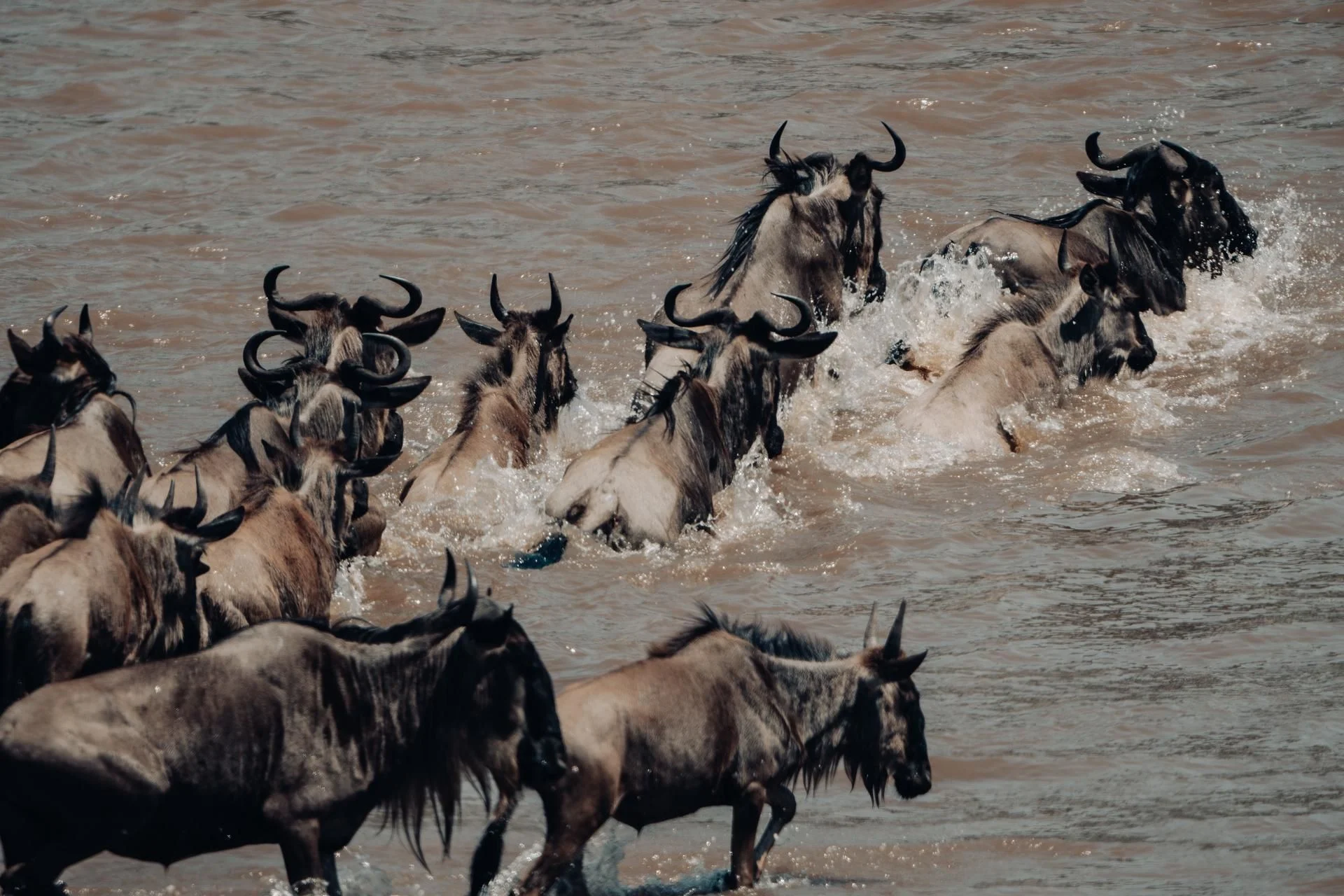
Timing an East Africa trip well requires holding two considerations simultaneously: the savanna parks’ dry-season preference, and the specific phase of the Great Migration you most want to witness, since calving season in Tanzania’s southern plains, the Grumeti River crossings, and the famous Mara River crossings each happen in genuinely different months and locations. Gorilla and chimpanzee trekking follow a similar dry-season preference for trail conditions, though both remain viable year-round, unlike a migration-focused safari where missing the right window means missing the specific spectacle entirely.
How to Sequence a Multi-Country Itinerary
For travellers combining two or more of East Africa’s four countries, sequencing matters both for the visa reasons already covered and for genuine logistical efficiency. A common and well-tested route pairs Kenya’s Masai Mara with Tanzania’s northern circuit, given the two ecosystems’ direct geographic connection, though this specific border crossing is more commonly done by domestic flight via Nairobi or Arusha than by road, given road conditions and distance. A second common route pairs Rwanda’s gorilla trekking with Uganda’s Bwindi, given the straightforward land border crossing between the two and the roughly two-hour drive separating Volcanoes National Park from the Uganda border.
Combining the savanna circuit (Kenya and Tanzania) with the primate circuit (Rwanda and Uganda) within a single trip is entirely possible and increasingly common, typically connected by a regional flight through Nairobi, Kigali, or Entebbe, but it does add genuine travel time and cost to an itinerary, and we’d generally recommend at least two to three weeks total to do this combination justice without feeling rushed through any single country.
Getting Around Within East Africa
Domestic flights connect most of the region’s major safari hubs efficiently, and using them strategically for longer transfers, rather than defaulting to road transport for every leg, meaningfully expands how many parks a fixed-length trip can comfortably cover. Road transfers remain the standard, and often the more scenic and cost-effective option, for shorter distances between adjacent parks, such as Tanzania’s northern circuit or Uganda’s western parks. Self-driving is a realistic option in parts of Kenya specifically, though it demands genuine 4×4 experience and confidence, and it’s not a broadly available option across Tanzania, Uganda, or Rwanda’s park systems in the way it is in parts of Kenya.
Matching Countries to Specific Priorities
Priority | Recommended Country Combination | Why |
Witnessing the Great Migration | Kenya and/or Tanzania | The migration exists specifically within the shared Mara-Serengeti ecosystem |
Gorilla trekking on a budget | Uganda | Roughly half Rwanda’s permit cost, with more habituated families overall |
The shortest, most efficient gorilla trekking logistics | Rwanda | A roughly 2.5-hour transfer from Kigali, among the shortest in the region |
A complete Big Five recovery story alongside gorillas | Rwanda (Volcanoes plus Akagera) | Akagera’s lion and rhino reintroduction adds genuine savanna variety |
The richest overall birdlife | Uganda | Over 1,090 recorded species, one of the highest counts of any African country |
A beach extension after the savanna | Kenya (Diani) or Tanzania (Zanzibar) | Both offer efficient, well-connected coastal extensions |
Frequently Asked Questions
Do I need separate visas for Kenya, Uganda, Rwanda, and Tanzania?
Kenya, Uganda, and Rwanda can be covered by a single East Africa Tourist Visa for 100 US dollars, valid 90 days with multiple entries between the three. Tanzania is never included in this joint visa and always requires its own separate application.
Which country should I enter first if I’m applying for the East Africa Tourist Visa in advance?
Whichever country you apply through must be your actual first point of entry. Applying through one country’s portal and then attempting to enter through a different one first can result in denial of entry, so plan your visa application around your genuine arrival sequence.
How many days do I need for a East Africa safari covering multiple countries?
A single-country trip can work well in seven to ten days. Combining two countries, such as Kenya and Tanzania, or Rwanda and Uganda, generally benefits from ten to fourteen days. Combining the savanna circuit with the primate circuit is best done over two to three weeks or more.
Is East Africa a malaria risk area?
Yes, malaria risk is present across most of the region’s main safari areas in all four countries, and anti-malarial medication is generally recommended. Confirm current guidance with a travel health professional for your specific itinerary.
Can I combine gorilla trekking with a classic savanna safari?
Yes, this is an increasingly common and well-supported combination, typically connecting Kenya or Tanzania’s savanna parks with Rwanda or Uganda’s gorilla trekking via a regional flight.
What’s the biggest budget factor in an East Africa trip that includes gorilla trekking?
The gorilla permit itself, a fixed fee of 800 US dollars in Uganda or 1,500 dollars in Rwanda, which sits entirely outside your daily accommodation and transport budget and applies regardless of how modestly or luxuriously you travel otherwise.
Is self-driving a realistic option anywhere in East Africa?
Only in parts of Kenya specifically, and it requires genuine 4×4 experience and confidence. Tanzania, Uganda, and Rwanda’s park systems don’t broadly support self-drive in the way Kenya’s road network does.