Pablo Gorilla Family in Volcanoes National Park
If any gorilla family deserves the word legendary, it is Pablo’s. Its roots go back to Group 5, one of the original research groups that Dian Fossey followed in the Virunga mountains.
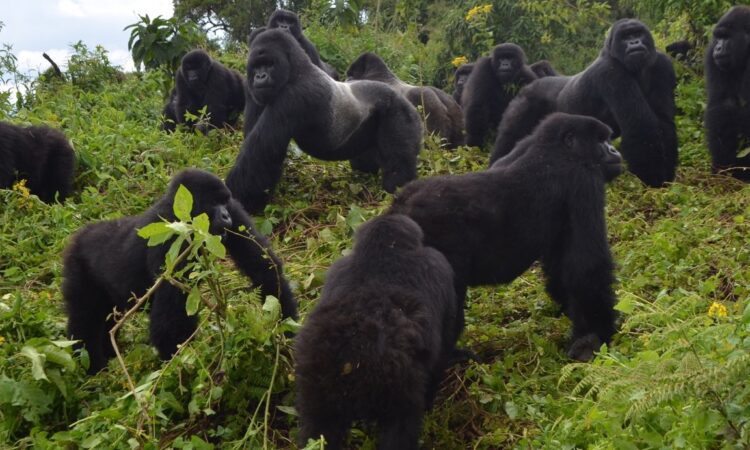
In 1993, when Group 5 split, a silverback named Pablo, born in August 1974, formed a group of his own, and under a later leader called Cantsbee, it grew to 65 gorillas, the largest mountain gorilla group ever recorded, in a species where the average group has about ten members.
The family later splintered, as very large groups do, and it has continued ever since under the watch of conservationists and veterinarians.
This guide tells that story and answers a question that many travelers ask: can I trek Pablo’s family? The honest answer is that sources disagree. The Dian Fossey Gorilla Fund describes the group’s history and its health monitoring in 2026; a 2026 operator page lists Pablo’s group among research groups that are not open to visitors, and several operator pages say that Pablo can be trekked.
This guide sets out what is known about the family’s history, explains the conflict over access, shows how to ask the right questions before you book and suggests ways to follow the story if you cannot meet the family itself.
Pablo’s Family at a Glance
The most reliable information in the sources comes from the Dian Fossey Gorilla Fund and the Gorilla Doctors, which both describe the family’s history in detail. The least reliable is the access information on operator pages, which varies by date and may be out of date.
| Fact | Detail |
| Origin | Dian Fossey’s Group 5, one of the original research groups in the Virunga Mountains |
| Founding the silverback | Pablo, born in August 1974 into Group 5 |
| Formed | 21 May 1993, when Group 5 split after the death of the dominant silverback Ziz; Pablo took 19 other gorillas and his brother Shinda took 16. |
| Peak size | 65 gorillas under the later leadership of Cantbee, the largest mountain gorilla group ever recorded |
| Later splits | Silverback Musilikale left with seven gorillas, and silverback Kureba left with seven, leaving 23 gorillas at the point the Fossey Fund’s timeline records. |
| Monitoring | Followed by researchers and veterinarians, with a health check recorded on 31 March 2026 |
| Visitor access | Disputed: described as a research group in some sources and as trekkable in others |
Roots in Fossey’s Group 5
The story begins with Dian Fossey, who studied several gorilla groups at Karisoke, including a historic group known as Group 5. Pablo was born into this group in August 1974, while Fossey was working in the forest, and the Fossey Fund’s own timeline places his birth alongside other events from her time, including the killing of members of another group, Group 4, which she also studied. One source says Fossey and her team first studied the group that became Pablo’s in 1976.
Group 5 was one of the research groups that made Karisoke famous, and the animals that were born into it were followed for their entire lives. That continuity of observation, from birth through adulthood to leadership, is exactly the type of long-term record that the research center is known for.
The 1993 Split: Pablo and Shinda
In 1993, the dominant silverback of Group 5, Ziz, died, and the group split. Pablo, then in his late teens, formed a new group on 21 May 1993 with 19 other gorillas, and his brother Shinda formed a group of 16. The two groups are sometimes named together in descriptions of the research families, as Pablo’s and Shinda’s groups.
The pattern is a familiar one. When a leader dies, a group may fragment as younger males compete for females and start their own families. It is an example of how the same families can produce several lines of descendants and why the Fossey Fund’s researchers describe groups by their history and not only by their current members.
Cantsbee and the Record: 65 Gorillas
Pablo’s group went on to achieve something extraordinary. Under the later leadership of a silverback called Cantsbee, who is described in one source as Pablo’s son, the group reached a record 65 individuals, the largest mountain gorilla group ever recorded.
The Fossey Fund notes that the average group size is about ten, so a group of 65 was more than six times the norm.
One source says that Cantosbee died young and that Pablo’s grandson now leads a family of 26 individuals. Large groups are hard to hold together, and Pablo’s group soon began to splinter, as the next section explains.
The record remains a reminder of how successful the group once was and of the pressures that come with size.
Splintering: What Happens to Very Large Groups
A very large group has more silverbacks, more females and more potential for conflict. Young males who reach maturity in a large group may wait for years for a chance to lead, and when a chance comes, or when tensions rise, they may leave and take females with them.
That is what the Fossey Fund’s timeline shows for Pablo’s group. After reaching 65 gorillas, the group began to splinter. One silverback, Musilikale, left with seven gorillas to form his own group, and later another, Kureba, left with seven more.
The Pablo group was left with 23 gorillas at the point recorded in that timeline. The groups that left are now families in their own right, which is how a single lineage can spread across the landscape.
Health, Snakes, and Veterinary Care
The Gorilla Doctors, the veterinary team that cares for wild mountain gorillas, published a health history of Pablo’s group in April 2026, describing the family as one whose story might have been very different without the life-saving interventions of veterinarians.
The article records a health check of members of the group on 31 March 2026, including an adult female, Teta, and her infant, and its categories include snares, one of the continuing threats to gorillas.
The details of individual cases are not given in the sources used for this guide, so this guide does not repeat them. The point for visitors is that families like Pablo’s are monitored closely and that interventions are sometimes needed to save injured or sick animals. Your permit fee helps to pay for protection and veterinary work.
A Gorilla Story on Screen
In April 2026, the Gorilla Doctors announced that A Gorilla Story, narrated by David Attenborough, premiered on Netflix, bringing the history of the Dian Fossey Gorilla Fund and the Pablo group to a global audience. If you want to follow the story of the family before or after your trip, the documentary is a good place to start, and it gives context for the reading and visiting that the Fossey Fund encourages.
Can You Trek Pablo’s Family? A Conflict in the Sources
The most careful reading is that Pablo’s group began as a research group, that it may have been opened to visitors at some point and that its current status is unclear. Several of the most authoritative 2026 sources discuss it as a monitored research family, and the 12 tourist families listed in most 2026 sources do not include it.
If you want to trek Pablo’s family, ask the Rwanda Development Board directly before you book, and do not build a trip around it.
| Source Type | What It Says |
| Dian Fossey Gorilla Fund, 2026 | Describes the group’s history and monitoring, with no mention of visitor treks |
| Gorilla Doctors, April 2026 | Describes health checks of the group by veterinarians |
| A 2026 operator page | Says there are 12 groups habituated for tourism and names research groups reserved for scientists, including Pablo’s and Shinda’s. |
| Older operator pages | Say Pablo’s family is open to tourists, or list it among the groups that can be trekked. |
| An older source | Says the group had 44 members in 2010 while still undergoing research and is now open to tourists. |
How to Ask the Right Questions Before You Book
Because the Rwanda Development Board assigns families at the 7 am briefing in Kinigi, even families that are open to visitors cannot be promised. Pablo’s family would be no different.
- Ask the Rwanda Development Board, or a licensed operator who will confirm with the Board, which groups are open to tourists on your dates.
- Ask for the answer in writing, with the date, since status can change.
- Ask whether any request to be assigned to a particular family is possible, and expect the answer to be no for standard permits.
- Be wary of any operator who promises Pablo’s group without confirming access with the Board.
- Ask what alternatives are available if the group is a research group and which families are similar in size and history.
If You Cannot Meet Pablo: Ways to Follow the Story
Each of these puts you closer to the story, and none depends on being assigned to a particular family. The gorillas you do meet may well be related to the lines that came from the groups Fossey studied.
| Option | What You Get | Notes |
| Trek Susa A or another Fossey-era family | A family whose line goes back to Fossey’s research | Susa A is the best known, though the assignment is made in the morning. |
| Visit the Ellen DeGeneres Campus. | Exhibits on research groups and the history of the Karisoke program | Open to visitors, with guided tours available |
| Hike to the Fossey grave. | The landscape where Group 5 and other groups were studied, and the grave beside Digit | About US$75 |
| Attend or follow Kwita Izina | The naming of infants born into the monitored families | Held each September |
| Watch the documentary and read the Fossey Fund’s account. | The history of Pablo’s group, told by those who follow it | Check availability and details. |
What Pablo’s Family Teaches Visitors
Even if you never meet the Pablo family, you can meet gorillas whose families have been shaped by the same forces. A good guide will tell you the stories of the families you do see, and they are often as dramatic.
- That gorilla groups are living, changing families, and that a lineage can spread across the landscape over decades.
- That the long-term records kept at Karisoke are what make such stories possible.
- That veterinary care and anti-snare work are part of conservation today.
- That visitor access is managed to protect the animals, and that some families are reserved for science.
- That a family’s story is more important than its label as tourist or research.
How Allocation Works for the Families You Can Visit
For the families that are open to visitors, the Rwanda Development Board does not allow visitors to request specific families in advance. At about 7 am in Kinigi, rangers assign each group of up to eight to a family based on tracker reports, fitness and the permit allocation. You can ask for a short or long hike, and tell the rangers about your fitness, but the park decides.
A permit costs US$1,500 per person per trek, with one hour with the gorillas, and roughly 10 percent of permit revenue is reported to be shared with communities around the park. Our separate guides compare budget, mid-range and luxury lodges near Volcanoes National Park.
Frequently Asked Questions
Who is Pablo in the Pablo gorilla family?
A silverback born in August 1974 into Dian Fossey’s Group 5, who formed his own group on 21 May 1993 after Group 5 split.
What is the record associated with the family?
Under a later leader called Cantsbee, the group reached 65 gorillas, the largest mountain gorilla group ever recorded.
Can I trek Pablo’s family?
Sources conflict. Some describe it as a research group and others as trekkable, so ask the Rwanda Development Board before you book.
How big is the group now?
The Fossey Fund records 23 gorillas after its splits, and other sources give 26 or 44, so sizes vary.
What can I do if I cannot trek it?
Trek another family, visit the Ellen DeGeneres Campus, hike to the Fossey grave or watch the documentary on the group.