Sempaya Hot Springs
Sempaya Hot Springs suits nearly any traveller already in western Uganda’s Fort Portal region, and requires very little in the way of prior planning or fitness: the shorter walk to the female spring, Nyansimbi, takes around fifteen minutes each way through palm forest, while the longer walk to the male spring, Bitende, takes closer to an hour along a forest trail and swamp boardwalk.
Neither route demands serious fitness, and both are suitable for most travellers comfortable with a moderate forest walk.
The honest framing here is that Sempaya is a worthwhile half-day activity, not a full-day destination in its own right. Travellers building an itinerary purely around the springs, without other interest in Semliki’s birding or the wider Fort Portal region, may find a single afternoon sufficient; those combining the visit with the park’s forest trails or a wider western Uganda circuit will find Sempaya a natural, low-effort addition rather than a standalone reason to travel this far.
Why Sempaya Matters
Two Springs, Two Very Different Characters
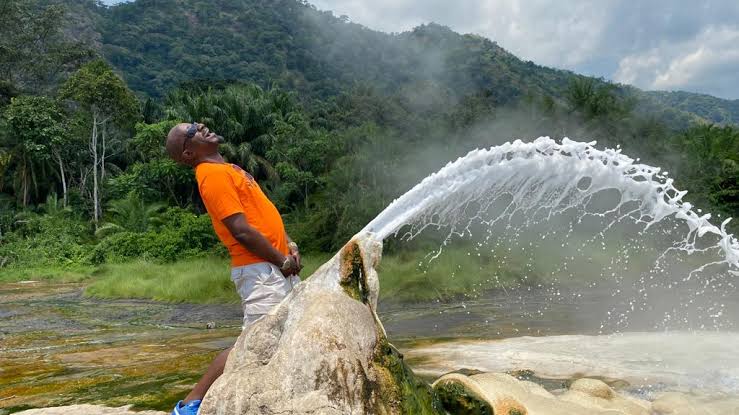
Nyansimbi, the female spring, is the more dramatic of the two: a genuine boiling geyser, spurting steaming water and bubbling activity up to two metres into the air, with a visible cloud of steam sometimes noticeable from a couple of kilometres away.
Bitente, the male spring, is calmer by comparison, a wide, steaming pool roughly twelve metres in diameter set in a swampy forest clearing with the Rwenzori Mountains visible as a backdrop on clear days. Most visitors see only Nyansimbi, given its shorter walk, but the two together offer a genuinely different pair of experiences within the same short outing.
A Site of Real Cultural Significance
The local Bamba people hold deep cultural beliefs tied to both springs, understanding female ancestral spirits to reside beneath Nyansimbi and male ancestral spirits beneath Bitente, with annual rituals still performed at the site to honour them.
Some local women continue to visit the springs for traditional purposes tied to fertility, and the warm waters have long been used practically for cooking, a tradition visitors can still participate in by boiling eggs or plantain bought locally at the boiling pools.
A Geological Window Into the Albertine Rift
The springs are a direct expression of the tectonic activity running through the Albertine Rift Valley, one of the more geologically active zones on the continent.
Their existence, bubbling up from considerable depth to reach the surface at boiling temperatures, offers a tangible, visible example of the geological forces shaping this part of East Africa, a detail that resonates particularly well with travellers who have an interest in earth science alongside wildlife and culture.
Not to Be Confused With Toro-Semliki Wildlife Reserve
Because Sempaya sits within Semliki National Park, it is worth repeating a distinction we make with nearly every client planning this visit: the neighbouring Toro-Semliki Wildlife Reserve, roughly twenty kilometres away, is a separate protected area entirely, offering open savannah and classic game drives rather than rainforest walking.
The two are sometimes bundled together in casual trip planning, but Sempaya’s hot springs are specifically within the national park, not the wildlife reserve, and travellers wanting both experiences should plan them as two distinct stops rather than assuming one visit covers both.
A Working Relationship Between Forest and Community
The Bamba communities living around Semliki’s boundary have long relied on the surrounding forest for both practical and spiritual purposes, and the springs sit at the intersection of both.
Local guides accompanying visitors to Sempaya are frequently drawn from these communities, and their explanations of the springs’ significance tend to go well beyond the geological facts, touching on family histories tied to specific rituals still performed at the site.
Travellers who take the time to ask questions during the guided walk often come away with a considerably richer understanding of the springs than the geological explanation alone provides.
Where Sempaya Fits Within Semliki and a Wider Itinerary
The Sempaya park office and trailhead sit within Semliki National Park itself, roughly an hour to ninety minutes from Fort Portal on generally good tarmac roads, itself five to six hours from Kampala. Because the springs require only a half-day, they combine naturally with Semliki’s other forest walks or with a wider western Uganda circuit including Kibale and Queen Elizabeth, rather than requiring a dedicated overnight stay purely for the springs alone.
| From | Approx. Distance / Time | Notes |
| Fort Portal | 1 – 1.5 hours | The standard staging point for a Sempaya visit. |
| Kampala / Entebbe (road) | 6 – 7.5 hours total | Via Fort Portal, on generally good tarmac roads. |
| Kibale National Park | 2 – 3 hours from Sempaya | Combinable for a wider western Uganda rainforest circuit. |
| Toro-Semliki Wildlife Reserve | About 20 km / 30 – 45 minutes | A separate protected area, useful for travellers also wanting game drives on the same trip. |
When to Visit
| Season | Months | What to Expect |
| Drier Spells | June – July, December – February | Firmer forest trails on the walk to both springs, generally the more comfortable window. |
| Wetter Periods | August – November, March – May | Higher rainfall typical of lowland rainforest, though the springs themselves remain fully active and visitable year-round. |
The springs’ boiling activity is a geothermal feature entirely independent of rainfall, so seasonal timing here matters mainly for trail comfort rather than the experience of the springs themselves. We do not consider any particular month a poor time to visit Sempaya specifically.
Budgeting for a Sempaya Visit
Sempaya is one of the more affordable activities on a Uganda itinerary. As of recent seasons, the Uganda Wildlife Authority has folded the once-separate hot springs walking fee into standard Semliki National Park entry, meaning visitors pay only the park’s regular entrance fee rather than an additional charge specifically for the springs. A guide accompanies all walks as standard practice, included within that entry arrangement.
| Tier | Approx. Cost (per person/night, full board) | What You Get |
| Budget | US$40 – 90 | Uganda Wildlife Authority bandas near Sempaya, or simple guesthouses in Bundibugyo town. |
| Mid-Range | US$120 – 220 | Comfortable lodges in Fort Portal, roughly an hour to ninety minutes from the springs. |
Given the springs’ modest cost and short walking time, most travellers treat Sempaya as a day excursion from Fort Portal rather than requiring dedicated overnight accommodation directly at the park.
Where to Stay
- Uganda Wildlife Authority bandas and campsites near the Sempaya park office, the simplest option directly at the site.
- Simple guesthouses in Bundibugyo town, a short distance from the springs, offering basic but adequate facilities.
- Comfortable mid-range lodges in Fort Portal, the most practical base for travellers treating Sempaya as a half-day excursion within a wider itinerary.
Visiting the Springs
- The Nyansimbi trail, roughly fifteen minutes each way through palm forest, leading to the dramatic, actively boiling female spring.
- The Bitente trail, roughly an hour each way via forest path and swamp boardwalk, leading to the calmer male spring with Rwenzori views on clear days.
- A guided combination visit to both springs, typically arranged as a single half-day outing with a Uganda Wildlife Authority ranger.
- The opportunity to cook eggs or plantain in the boiling pools around Nyansimbi, a traditional practice visitors are welcome to take part in.
- Birding along the trail itself, since the palm forest and swamp habitat en route to both springs supports a strong selection of the park’s wider bird list.
Combining Sempaya With a Dedicated Birding Trip
For travellers whose Uganda itinerary is built specifically around birding rather than general wildlife viewing, Sempaya sits naturally alongside Semliki’s Kirumia and Red Monkey trails as part of a longer, dedicated forest birding circuit. Serious birders sometimes allocate two to three days to Semliki specifically for this reason, treating the hot springs as one stop among several rather than the singular highlight, and pairing the visit with similarly forest-focused birding at Kibale or Bwindi elsewhere in the itinerary.
Planning Advice
- Budget a half-day for both springs together, or a shorter visit if only seeing Nyansimbi, the more accessible of the two.
- Wear closed, comfortable walking shoes; the trail to Bitente crosses a swamp boardwalk that can be slick after rain.
- Combine the springs with one of Semliki’s other forest trails, the Sempaya nature trail or a stretch of the Kirumia Trail, if you have a full day rather than a half-day available.
- Approach the springs with the same cultural respect given to any active religious site, since they hold genuine ongoing spiritual significance to the local Bamba community.
- Base yourself in Fort Portal rather than seeking dedicated luxury accommodation directly at Sempaya, given the limited options at the park itself.
Who Sempaya Suits Best
| Traveller Type | Recommendation |
| Traveller already visiting Semliki or Kibale | Excellent, low-effort addition requiring only a half-day. |
| Family with children | Well suited to the shorter Nyansimbi walk; the longer Bitente route is manageable for most fitness levels but requires more stamina. |
| Traveller with a strong interest in geology or culture | Particularly rewarding given the springs’ tectonic origin and genuine ongoing cultural significance. |
| Traveller seeking a dedicated full-day destination | Better served combining Sempaya with Semliki’s broader forest trails or the wider Fort Portal region. |
| Photographer | Strong candidate, particularly for the dramatic steam and bubbling activity at Nyansimbi. |
| Budget-conscious traveller | Genuinely strong value given the modest, now-included park entry cost. |
Frequently Asked Questions
Is there a separate fee to visit Sempaya Hot Springs?
No, as of recent seasons the Uganda Wildlife Authority has folded the hot springs walking fee into standard Semliki National Park entry, so visitors pay only the regular park entrance fee rather than an additional charge specifically for the springs.
Can I visit both springs in one trip?
Yes, and this is the standard arrangement. A guided half-day visit typically covers both Nyansimbi, a short fifteen-minute walk, and Bitente, roughly an hour’s walk, though travellers short on time sometimes visit only Nyansimbi given its shorter access.
Are the hot springs safe to touch or enter?
The boiling pools around Nyansimbi reach genuinely high temperatures and should not be entered; visitors instead use the boiling water to cook eggs or plantain purchased locally, a traditional practice rather than a bathing activity.
How long does the walk to the springs take?
Around fifteen minutes each way to Nyansimbi, and closer to an hour each way to Bitente, both on generally manageable forest and boardwalk terrain suitable for most fitness levels.
Do I need to stay overnight at Semliki to see the springs?
No. Most travellers visit as a half-day excursion from Fort Portal, roughly an hour to ninety minutes away, rather than requiring overnight accommodation directly at the park.
What else can I combine with a Sempaya visit?
Semliki’s other forest trails, particularly the shorter Sempaya nature trail, combine naturally with the springs on the same visit. For a longer itinerary, Kibale National Park and the wider Fort Portal region, including its crater lakes, are a natural extension.