Chimpanzee Trekking in Uganda
Chimpanzee trekking tends to get discussed as a single, uniform activity, but Uganda actually offers four genuinely distinct sites, Kibale Forest, Kyambura Gorge, Budongo Forest, and Semliki, and the choice between them matters considerably more than most general advice suggests. Success rates, trek length, and terrain all vary meaningfully by site, and choosing based on convenience alone, whichever park happens to be nearest your other stops, sometimes means settling for a noticeably lower chance of a good sighting than a small amount of additional planning would deliver.
This guide works at the country level, comparing Uganda’s four chimpanzee trekking sites directly so you can choose deliberately, then covers how the activity itself works, what a habituation experience adds beyond standard trekking, and how chimpanzee trekking compares to gorilla trekking for travellers weighing both. Our dedicated Kibale guide goes further into that specific park’s lodges and logistics; this page exists to help with the higher-level site decision first.
How Chimpanzee Trekking Works
A chimpanzee trekking permit buys a guided search for a habituated community, typically running one to three hours, with a standard one-hour viewing window once the group is located: unlike gorillas, who tend to move and rest at a more measured pace, chimpanzees travel through the canopy and understory with considerably more speed and unpredictability, which changes the character of the encounter itself. Sightings remain highly likely at Uganda’s better-established sites, but the viewing experience often involves more movement and repositioning than a typical gorilla encounter, as guides work to keep the group in view.
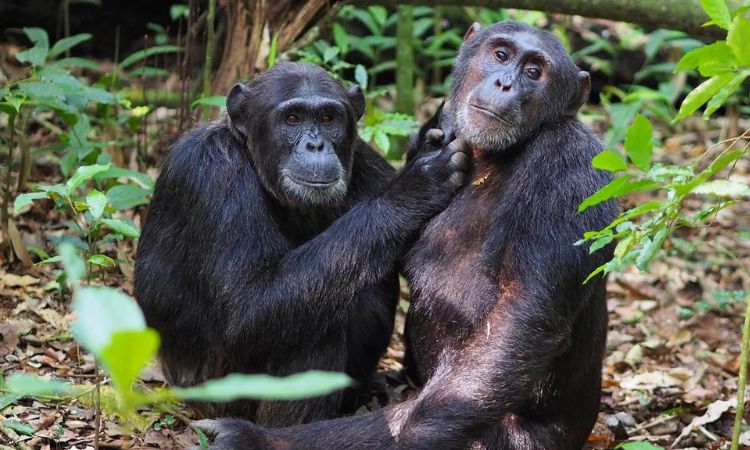
Trekkers gather at a site’s visitor centre for an early morning briefing before setting out with a ranger guide and, at the more established sites, a tracker team already working in the forest. Standard rules apply across all four locations: a minimum viewing distance, no flash photography, and no eating, drinking, or smoking in the chimpanzees’ presence, all designed to protect a species that shares close to ninety-eight percent of human DNA and remains genuinely susceptible to human illness.
Comparing Uganda’s Four Chimpanzee Trekking Sites
| Site | Approx. Success Rate | Trek Length | Best For |
| Kibale Forest National Park | Very high, generally above 90% | 2 – 3 hours | Travellers whose main priority is a reliable, well-established chimp encounter |
| Kyambura Gorge, Queen Elizabeth NP | Moderate | 2 – 4 hours | Travellers already at Queen Elizabeth wanting to add chimp tracking without a separate trip to Kibale |
| Budongo Forest, near Murchison Falls | Good, improving as habituation continues | 2 – 3 hours | Travellers already at Murchison Falls wanting an efficient add-on |
| Semliki National Park | Lower, less habituated communities | Variable, often a full day | Travellers with a specific interest in Semliki’s rainforest ecology, not a dedicated chimp-focused visit |
Kibale stands apart as Uganda’s clearest recommendation for travellers whose central goal is a reliable chimpanzee encounter, owing to its larger habituated communities and considerably longer tracking history than the other three sites. Kyambura Gorge and Budongo Forest both work well as efficient additions for travellers already visiting Queen Elizabeth national park or Murchison Falls respectively, without requiring a dedicated detour to Kibale. Semliki’s chimpanzees are the least reliably sighted of the four, and we generally position that park’s appeal around its rainforest birding and the Sempaya hot springs rather than chimpanzee trekking specifically.
The Chimpanzee Habituation Experience
Kibale offers a full-day habituation experience as an alternative to the standard two to three hour trek, following researchers and trackers as they follow a community from dawn nesting sites through a complete day of foraging, social interaction, and rest. This considerably deeper encounter costs meaningfully more than the standard trek and demands a longer physical commitment, but offers genuine behavioural insight that a shorter, standard trek cannot match. We recommend it specifically to travellers with a real interest in primate behaviour and research, rather than as a default upgrade.
Chimpanzee Trekking vs. Gorilla Trekking
Travellers weighing the two activities against each other should understand a few genuine differences beyond cost. Chimpanzee trekking is considerably less expensive, generally around 200 US dollars per person at Kibale compared to roughly 800 US dollars for a standard gorilla permit, and the standard trek is typically shorter and less physically demanding than most Bwindi gorilla trekking sectors. What chimpanzee trekking does not offer is the same calm, close-range, extended viewing that defines a gorilla encounter; chimpanzees move faster and more unpredictably, and the encounter often feels more dynamic and less contemplative as a result.
Many of our clients do both on the same trip rather than choosing one over the other, since Kibale sits naturally between Queen Elizabeth and Bwindi on a standard western Uganda circuit, adding relatively little extra transfer time to include both primate experiences.
How Trackers Locate the Chimpanzees Each Morning
At all four sites, a small tracker team enters the forest ahead of the main trekking group, often before dawn, working from knowledge of the community’s overnight nesting location and typical movement patterns to establish roughly where the group is likely to be. This system is considerably less formalised at Semliki, where communities remain less habituated and less consistently monitored, which is part of why success rates there trail the other three sites. At Kibale specifically, decades of continuous research presence mean tracking data is unusually rich, contributing directly to the site’s high and consistent success rate.
Fitness and Physical Preparation
Chimpanzee trekking demands less sustained physical effort than most Bwindi gorilla trekking sectors, but reasonable fitness still matters, particularly at Semliki, where treks can extend across a full day if the community has moved far from its usual range. Kibale and Kyambura Gorge treks are generally manageable for most travellers with moderate walking fitness, while Budongo Forest sits somewhere between the two depending on which section of forest the day’s search covers.
Combining Multiple Chimpanzee Trekking Sites on One Trip
A smaller number of travellers, generally those with a genuine research or conservation interest, choose to visit two or more of Uganda’s four chimpanzee sites on a single trip specifically to compare habituation levels and community behaviour firsthand. This is a considerably more specialised itinerary than most travellers need, and we generally advise against it for a first Uganda visit, where time is better spent at Kibale alone plus one savannah park, but it is a genuinely interesting option for repeat visitors or those with an academic or professional interest in primatology.
Where Chimpanzee Trekking Fits on a Uganda Itinerary
| Site | Approx. Distance from Kampala | Natural Pairing |
| Kibale Forest National Park | 4 – 5 hours by road | Queen Elizabeth National Park, 2 – 3 hours further |
| Kyambura Gorge (Queen Elizabeth NP) | 5 – 6 hours by road | Already within Queen Elizabeth; no separate transfer needed |
| Budongo Forest (near Murchison Falls) | 5 – 6 hours by road, or ~1 hour by air | Already on the approach road to Murchison Falls |
| Semliki National Park | 6 – 7.5 hours by road via Fort Portal | Kibale, 2 – 3 hours further, for a combined western rainforest circuit |
When to Go Chimpanzee Trekking
Unlike savannah game viewing, chimpanzee tracking success is not strongly seasonal at any of the four sites, since trackers follow known nesting and feeding patterns rather than relying on dry-season water concentration. The dry season windows, June to August and December to February, offer firmer, more comfortable forest trails, but sightings themselves hold up well throughout the year, including the wetter months when trail conditions are muddier but crowds and prices are both considerably lower.
How Trekking Fees Support Conservation
A portion of every chimpanzee trekking permit fee is directed toward park management and, at several sites, directly toward community revenue-sharing programmes that fund schools, health clinics, and other local infrastructure in villages bordering the forest. This funding model is part of why Uganda Wildlife Authority and community-run sites alike maintain such consistent enforcement of trekking rules, since the long-term value of the tourism revenue depends directly on maintaining healthy, undisturbed communities capable of sustaining regular visitor traffic for years to come.
Planning Advice
- Choose Kibale as the default site for travellers whose central priority is a reliable chimpanzee encounter, given its considerably higher success rate than the alternatives.
- Add Kyambura Gorge or Budongo Forest as efficient extensions when already visiting Queen Elizabeth or Murchison Falls national park, rather than as standalone destinations.
- Book permits at least a few weeks ahead for peak dry-season travel; availability is generally more forgiving than Bwindi’s gorilla permits but should not be left to the last minute.
- Consider the full-day habituation experience at Kibale specifically if genuine behavioural insight, rather than a standard sighting, is your priority.
- Pack sturdy walking shoes, a light rain jacket, and gardening-style gloves regardless of season or site, since all four locations involve genuine rainforest terrain.
Who Chimpanzee Trekking Suits Best
| Traveller Type | Recommendation |
| Primate enthusiast prioritising a reliable sighting | Kibale Forest, given its considerably higher success rate. |
| Traveller already visiting Queen Elizabeth or Murchison Falls | Kyambura Gorge or Budongo Forest respectively, as an efficient add-on. |
| Traveller who could not secure a gorilla permit | Kibale Forest offers a genuinely rewarding, considerably less expensive alternative primate encounter. |
| Serious student of primate behaviour | Kibale’s full-day habituation experience, for deeper behavioural insight. |
| Birder visiting Semliki for other reasons | Chimpanzee trekking there is a worthwhile bonus, not the main draw. |
| Family with moderate fitness levels | Kibale’s standard trek, generally more accessible than most Bwindi gorilla trekking sectors. |
Frequently Asked Questions
Which is the best site for chimpanzee trekking in Uganda?
Kibale Forest National Park, given its considerably higher tracking success rate and larger, longer-habituated communities compared to Kyambura Gorge, Budongo Forest, or Semliki. It is the site we recommend by default whenever a client’s central priority is simply the most reliable chimpanzee encounter available.
How does chimpanzee trekking compare to gorilla trekking?
Chimpanzee trekking is less expensive, generally shorter, and less physically demanding, but the encounter itself is more dynamic and less calm than a typical gorilla viewing, since chimpanzees move faster and less predictably through the forest.
Can I do chimpanzee trekking and gorilla trekking on the same trip?
Yes, and many travellers do exactly this, since Kibale sits naturally between Queen Elizabeth and Bwindi on a standard western Uganda circuit, adding minimal extra transfer time.
What is the chimpanzee habituation experience?
A full-day activity at Kibale following a community from dawn nesting sites through a complete day’s behaviour, offering deeper insight than the standard two to three hour trek, at higher cost and with a longer physical commitment.
Is chimpanzee trekking suitable for children?
Generally yes, more so than gorilla trekking, given the typically shorter and less physically demanding standard trek at Kibale, though minimum age policies should be confirmed directly with your operator.
How much does chimpanzee trekking cost?
Generally around 200 US dollars per person at Kibale for the standard trek, with the full-day habituation experience priced higher. Prices at Kyambura Gorge, Budongo Forest, and Semliki are broadly comparable, though should be confirmed given periodic revisions, and none of these fees include park entry, which is charged separately at each site.