Rwanda Gorilla Trekking Vs Uganda Gorilla Trekking
Rwanda Gorilla Trekking Vs Uganda Gorilla Trekking; Both Rwanda’s Volcanoes National Park and Uganda’s Bwindi Impenetrable National Park deliver genuinely excellent mountain gorilla encounters. The differences between them are real, but they are differences of degree and priority, not of one being simply better than the other.
This guide compares the two directly, cost, terrain, logistics, and trekking experience, so you can weigh the trade-offs against your own specific priorities rather than defaulting to whichever destination is mentioned first in general travel content.
Cost:
Rwanda’s gorilla permit costs 1,500 US dollars per person, compared to Uganda’s 800 US dollars, a difference of 700 dollars per trekker that compounds quickly for couples, families, or groups: Rwanda does offer a 30% low-season discount, bringing the fee to 1,050 dollars for travellers who also spend genuine time at both Akagera and Nyungwe between November and May, narrowing but not eliminating the gap. For budget-conscious travellers, this is often the single deciding factor, and reasonably so.
Logistics:
Rwanda’s Volcanoes National Park sits two and a half to three hours from Kigali International Airport, among the shortest transfers to any major gorilla trekking destination in the region.
Uganda’s Bwindi, by contrast, requires eight to nine hours by road from Kampala or Entebbe, or a shorter domestic flight to Kihihi or Kisoro airstrips. For travellers with limited time or a strong preference for minimising long transfers, Rwanda’s logistics represent a genuine, meaningful advantage.
Terrain:
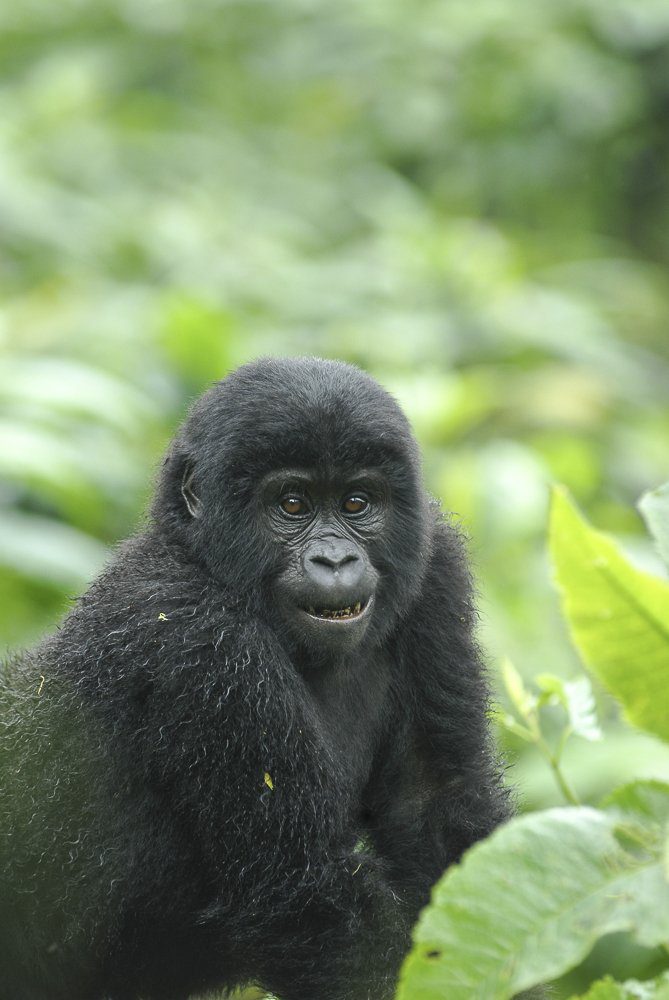
Bwindi’s dense montane rainforest terrain varies considerably by sector, Buhoma offering gentler access, Rushaga and Nkuringo considerably steeper and more physically demanding. Volcanoes National Park’s terrain, volcanic slopes and bamboo forest, is generally more uniform across its trekking area, which some travellers find easier to plan around, while others prefer Uganda’s variety, allowing a sector choice matched more precisely to fitness level.
Sector and Family Variety
Uganda offers considerably more trekking variety, four distinct Bwindi sectors plus Mgahinga, each with different terrain, lodges, and habituated families. Rwanda offers a single trekking area at Volcanoes National Park with twelve tourist-accessible families, less variety in terrain and lodge geography, but a more streamlined, centralized booking and logistics experience as a result.
Direct Comparison
| Factor | Rwanda (Volcanoes NP) | Uganda (Bwindi) |
| Permit cost | US$1,500 (US$1,050 low season with multi-park stay) | US$800 |
| Transfer from airport | 2.5 – 3 hours | 8 – 9 hours by road, or a short flight |
| Terrain | Volcanic slopes, generally uniform | Dense rainforest, varies considerably by sector |
| Trekking variety | Single park, 12 tourist-accessible families | Four sectors plus Mgahinga, each genuinely different |
| Habituation experience available | Yes, at considerable extra cost | Yes, in Rushaga and Nkuringo sectors |
| Overall trek difficulty | Moderate | Moderate to strenuous, depending on sector |
Booking Process:
Rwanda’s gorilla permits are booked directly through the Rwanda Development Board’s online system or via a licensed operator, with full payment generally required well ahead of your trekking date and a strict non-refundable, non-transferable policy once issued.
Uganda’s Bwindi permits follow a broadly similar advance-payment structure through the Uganda Wildlife Authority, though the country’s four sectors mean your operator plays a more active role in matching your specific sector choice to lodge and transfer logistics, a layer of complexity Rwanda’s single trekking area avoids.
The Overall Trekking Day
A Rwanda trekking day begins at Kinigi park headquarters with a single, well-organised briefing process before groups disperse to their assigned families. A Uganda trekking day begins at one of four separate sector headquarters, each with its own character and level of established infrastructure, Buhoma being the most polished and long-established, Rushaga and Nkuringo somewhat newer to large-scale tourism.
Neither approach is inherently superior; Rwanda’s centralisation trades away choice for simplicity, while Uganda’s sector system trades away simplicity for genuine variety.
Which Destination Suits Which Priority
Choose Rwanda If…
- Minimising transfer time and overall trip logistics matters more to you than cost.
- You want a single, highly organised, centralised trekking experience without needing to choose between sectors.
- You are also planning a genuine multi-park Rwanda circuit and can time your trip for the November-May low-season discount.
- You prefer generally more uniform, moderate terrain over Uganda’s more variable sector difficulty.
Choose Uganda If…
- Cost is a significant factor in your decision, given the meaningful 700 dollar per-person difference.
- You want genuine choice in trekking sector and terrain, matching difficulty more precisely to your fitness level.
- You are building a wider Uganda itinerary including chimpanzee trekking, savannah parks, or the Rwenzoris.
- You are comfortable with a longer transfer, whether by road or a short domestic flight, in exchange for lower overall cost.
Accommodation Comparison
Both destinations offer a full range of budget, mid-range, and luxury accommodation, though Rwanda’s luxury tier includes some of the most architecturally distinctive lodges in East Africa, Bisate Lodge and Virunga Lodge among them, generally at a higher price point than comparable Uganda properties near Bwindi.
Uganda’s accommodation, particularly at the mid-range tier, tends to offer strong value given the country’s lower overall cost structure, making a comfortable stay somewhat more accessible on a moderate budget than Rwanda’s equivalent tier.
Can You Do Both?
Yes, and this is a genuinely popular option for travellers with the time and interest. Uganda’s southwestern parks sit close to the Rwandan border, and a combined circuit trekking gorillas in both Bwindi and Volcanoes National Park, or trekking in one and adding golden monkeys or chimpanzees in the other, is a straightforward, well-established itinerary that many of our clients choose specifically to compare the two experiences firsthand.
Planning Advice
- Weigh cost and logistics against each other honestly, since neither destination is objectively superior; they simply serve different priorities.
- If choosing Rwanda specifically for the low-season discount, plan genuine multi-night stays at both Akagera and Nyungwe to actually qualify.
- If choosing Uganda, select your Bwindi sector deliberately based on fitness level rather than defaulting to whichever lodge looks best in photographs.
- Consider combining both countries if time and budget allow, since the border crossing between southwestern Uganda and northern Rwanda is straightforward.
- Book permits for either country well in advance, six to twelve months for Rwanda’s peak season, three to six months for Uganda, given fixed daily capacity in both.
Frequently Asked Questions
Is Rwanda or Uganda better for gorilla trekking?
Neither is objectively better; they suit different priorities. Rwanda offers shorter transfers and a more centralised experience at higher cost. Uganda offers considerably lower cost and greater sector variety at the cost of longer transfers.
Why is Rwanda’s gorilla permit so much more expensive than Uganda’s?
Rwanda has positioned its gorilla trekking as a premium, highly organised experience with shorter transfer times and a more centralised system, reflected directly in its pricing. Uganda’s lower cost reflects its different infrastructure and broader distribution of trekking across multiple sectors and parks.
Is the trekking terrain easier in Rwanda or Uganda?
Generally more uniform in Rwanda, given its volcanic-slope terrain across a single trekking area. Uganda’s terrain varies considerably by Bwindi sector, from Buhoma’s gentler access to Rushaga and Nkuringo’s steeper trails.
Can I combine gorilla trekking in both countries on one trip?
Yes, this is a common and workable combination, particularly for travellers wanting to compare both experiences, given the relatively straightforward border crossing between southwestern Uganda and northern Rwanda.
Which country has better gorilla habituation experiences?
Both offer this extended, deeper encounter option, Rwanda at considerable additional cost, Uganda specifically in the Rushaga and Nkuringo sectors, also at a meaningful premium over standard trekking.
Does either country offer a more reliable gorilla sighting rate?
Both countries report very high overall success rates, generally above ninety-five percent, since trackers in both locations locate families fresh each morning using established monitoring. Neither destination holds a meaningful edge in sighting reliability; the choice comes down to cost, logistics, and terrain preference rather than likelihood of success.