Mount Kenya National Park
Mount Kenya National Park protects the upper slopes of an extinct volcano straddling the equator in central Kenya, roughly 175 kilometres north of Nairobi. A UNESCO World Heritage Site, the park covers the mountain’s forest, moorland, and glaciated summit zones, with Batian, its highest point, reaching 5,199 metres, making Mount Kenya Africa’s second-highest peak after Kilimanjaro.
Overview
Mount Kenya occupies a genuinely distinctive place among East Africa’s great mountains. Its trekking summit, Point Lenana at 4,985 metres, requires no technical climbing equipment or rope work, putting it within reach of fit, well-prepared hikers in a way that its true summits are not. Batian, at 5,199 metres, and Nelion, at 5,188 metres, are an entirely different proposition: genuine rock and ice climbs requiring ropes, harnesses, and a licensed mountaineering guide, more technically demanding than anything on Kilimanjaro.
The mountain draws roughly 15,000 visitors a year, a fraction of Kilimanjaro’s much larger numbers, giving Mount Kenya a genuinely wilder, quieter character despite its comparable trekking difficulty. For travellers who want a serious high-altitude trek without the crowded trails and permanent hut infrastructure that Kilimanjaro has developed, Mount Kenya is often described as the more rewarding, if less internationally famous, alternative.
The Kikuyu people call the mountain Kirinyaga, meaning mountain of whiteness, a reference to its snow-capped peaks, and the three summits are traditionally named after Maasai prophets: Batian the eldest, Nelion his brother, and Lenana the youngest.
Best Time to Visit
The dry seasons, January through March and June through October, offer the best trekking conditions across all three main routes, with clearer skies and firmer trails. Guides on the mountain read the weather through the summit’s visibility: ‘the giant is awake’ means clear skies ahead, while ‘the giant is under his blanket’ signals cloud cover and likely afternoon rain.
Non-resident adult entry currently runs at approximately 80 US dollars per 24-hour period, under the Kenya Wildlife Service’s Mountain Park fee category, effective under the revised October 2025 tariff. Since most treks take four to six days, budgeting for multiple days of park entry is essential when planning costs. Climbers ascending to Point Lenana, Batian, or Nelion require a climbing permit in addition to the standard conservation fee.
Getting There and Where to Stay
Getting There
Most treks begin from Nanyuki or Chogoria, both reachable from Nairobi in roughly four to five hours by road. The three main trailheads, Sirimon Gate in the northwest, Naro Moru Gate to the west, and Chogoria Gate to the east, each connect to a distinct route up the mountain, and your choice of route determines which trailhead town makes the most sense as a starting point.
Where to Stay
Nanyuki offers the widest range of accommodation for climbers preparing for a Sirimon or Naro Moru route trek, from comfortable mid-range lodges to simpler guesthouses. Chogoria town serves climbers using the eastern route. On the mountain itself, a network of huts and campsites, including Old Moses Camp, Shipton’s Camp, and Mackinder’s Camp, provide overnight stops along the main routes, generally arranged as part of a guided trekking package.
Activities
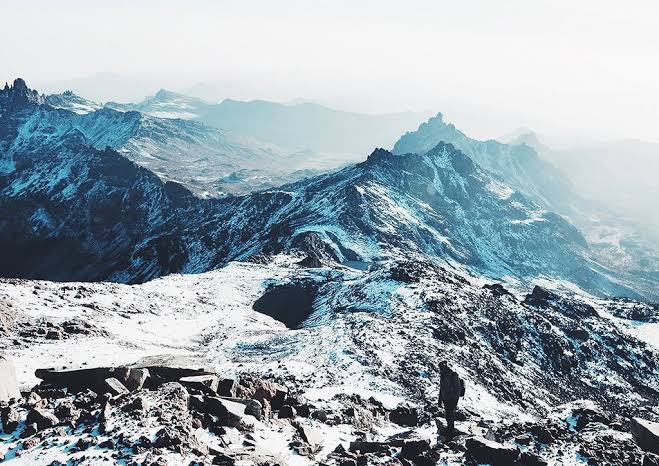
Mount Kenya’s activities centre almost entirely on its three established trekking and climbing routes, each offering a genuinely different character and difficulty profile.
Trekking the Sirimon Route
Widely considered the easiest and most scenic route up the mountain, Sirimon approaches from the northwest with a gradual ascent profile that supports good acclimatisation, passing through diverse vegetation zones and a notably high concentration of wildlife in its lower sections.
Trekking the Naro Moru Route
The shortest and most direct route to Point Lenana, Naro Moru is also the steepest, including a genuinely challenging section known as the Vertical Bog, a name that gives a fairly accurate sense of what to expect underfoot.
Trekking the Chogoria Route
Regarded as the most scenic of the three routes, Chogoria traverses the dramatic Gorges Valley, passing Lake Ellis, Lake Michaelson, and Nithi Falls along the way. It’s often used for descent specifically to take in this scenery after an ascent via Sirimon or Naro Moru.
Technical Climbing to Batian or Nelion
For experienced mountaineers only, summiting either of Mount Kenya’s true peaks requires full technical climbing gear, ropes, and advanced rock-climbing skills, considered by many climbers to be more challenging than Kilimanjaro despite Mount Kenya’s lower overall elevation.
Trout Fishing at Lake Ellis
Along the Chogoria route, Lake Ellis offers a genuinely peaceful trout fishing opportunity for trekkers wanting to combine the ascent with a quieter, more contemplative activity.
Attractions
Mount Kenya’s attractions are inseparable from its geology and its position as one of Africa’s great equatorial peaks.
Point Lenana
At 4,985 metres, this is the mountain’s trekking summit and the objective for the vast majority of visitors, offering a genuine high-altitude achievement without requiring technical climbing skill.
Batian and Nelion
The mountain’s true summits, both technical rock and ice climbs, standing as some of the most serious mountaineering objectives in East Africa.
The Gorges Valley and Lake Michaelson
Found along the Chogoria route, this dramatic valley and its associated tarn are widely considered the most visually striking scenery anywhere on the mountain.
Mount Kenya’s Glaciers
Though retreating, as glaciers are across equatorial Africa, the mountain’s remaining ice fields near the summit add a genuinely striking visual element rarely associated with a location sitting almost directly on the equator.
The Volcanic Formations
As an extinct volcano last active roughly 2.6 to 3.1 million years ago, the mountain’s jagged current form, including formations known as the Gates and Midget Peak, reflects millions of years of glacial erosion acting on what was originally a much larger, rounder volcanic cone.
Wildlife Highlights
Forest Zone Wildlife
The mountain’s lower forest belt supports elephant, buffalo, and various primates, encountered most often on the approach to the higher trekking zones rather than at altitude itself.
The Three-Horned Chameleon
This distinctive, endemic reptile is one of the more memorable smaller wildlife encounters trekkers report along the lower sections of the mountain’s trails.
High-Altitude Birdlife
The moorland and alpine zones support a range of high-altitude bird species adapted to Mount Kenya’s cold, thin air, distinct from the forest species found lower down.
Fun Facts
- Mount Kenya is a UNESCO World Heritage Site, recognised for both its dramatic geology and its distinct high-altitude ecosystems.
- The mountain’s three peaks are named after Maasai prophets, or laibons: Batian, Nelion, and Lenana.
- Mount Kenya sees roughly 15,000 visitors annually, a fraction of Kilimanjaro’s numbers, giving it a genuinely wilder, less developed trekking experience.
- The mountain was an active volcano between roughly 2.6 and 3.1 million years ago, and its current jagged shape is the result of extensive glacial erosion over that time.
- Technical climbers consider summiting Batian or Nelion more challenging than climbing Kilimanjaro, despite Mount Kenya’s lower overall elevation.
Frequently Asked Questions
Do I need climbing experience to trek Mount Kenya?
Not to reach Point Lenana, the trekking summit at 4,985 metres, which requires no technical equipment or prior climbing experience. Batian and Nelion, the mountain’s true summits, require full technical climbing skills and gear.
Which route is best for a first-time trekker?
The Sirimon route is generally considered the easiest and most scenic, offering a gradual ascent that supports good acclimatisation.
How does Mount Kenya compare to Kilimanjaro?
Mount Kenya is lower in elevation but arguably more varied, offering both a non-technical trekking summit comparable in difficulty to Kilimanjaro and genuinely technical rock climbs that Kilimanjaro has no equivalent of. It also sees far fewer visitors, giving it a wilder feel.
How long does a Mount Kenya trek take?
Most treks to Point Lenana take four to six days depending on the route and acclimatisation schedule chosen.
What is the best time of year to climb?
January through March and June through October offer the best trekking conditions, with clearer skies and firmer trails than the wetter months.