Amboseli National Park
Amboseli National Park lies in Kajiado County in southern Kenya, hard against the Tanzanian border, about 240 kilometres, roughly four to five hours by road, southeast of Nairobi. At 392 square kilometres it’s compact, built around a former lake bed and a handful of permanent swamps fed by underground run-off from Kilimanjaro.
Overview
Amboseli sits in the rain shadow of Mount Kilimanjaro, and though it’s one of Kenya’s smaller parks, its combination of open plains, seasonal swamps and that famous mountain backdrop makes it disproportionately popular, and deservedly so. This is the park most safari photographers picture when they imagine Africa: a line of elephants crossing dust or grassland with Kilimanjaro’s snow-capped summit rising behind them.
The park’s ecosystem is unusual. Underground water filtering down from Kilimanjaro’s ice cap feeds a series of permanent swamps, Enkongo Narok, Olokenya and others, that stay green even in the dry season, drawing wildlife from a much wider surrounding area. That concentration effect is what makes Amboseli so productive for game viewing despite its modest size.
The park forms only part of a much larger Amboseli ecosystem, including neighbouring group ranches and community conservancies where Maasai landowners have increasingly turned to conservation-based tourism alongside traditional livestock herding, a landscape considerably larger and more interconnected than the national park’s own formal boundary suggests.
Best Time to Visit
The dry months of June to October and January to February are best for wildlife viewing, since scarce water pushes animals to concentrate around the park’s permanent swamps. Those same dry months, particularly January and February mornings, also give the clearest views of Kilimanjaro before afternoon cloud builds up. April and May bring heavy long rains and are best avoided unless you’re chasing low-season rates.
Amboseli is a Kenya Wildlife Service park with a flat, year-round entry fee, currently around 90 US dollars per non-resident adult, making budgeting for a visit here considerably more straightforward than for county-managed reserves with seasonal pricing.
Getting There and Where to Stay
Getting There
Scheduled flights from Nairobi’s Wilson Airport reach Amboseli’s own airstrip in well under an hour, making this one of the easiest parks in Kenya to combine with a short trip. By road, two routes run from Nairobi, via Namanga (about 240 km, 4-5 hours) or via Emali on the Nairobi-Mombasa highway (about 228 km, 3-4 hours), both manageable as a long day trip if you’d rather drive.
Where to Stay
Lodges and camps split between those inside the park boundary, offering the shortest possible drive to the swamps each morning, and those in surrounding conservancies and group ranches, which allow walking safaris and night drives the park itself doesn’t permit. Options span the full range from the long-established Amboseli Serena and Ol Tukai Lodge to smaller tented camps like Tortilis, positioned for Kilimanjaro views over dinner.
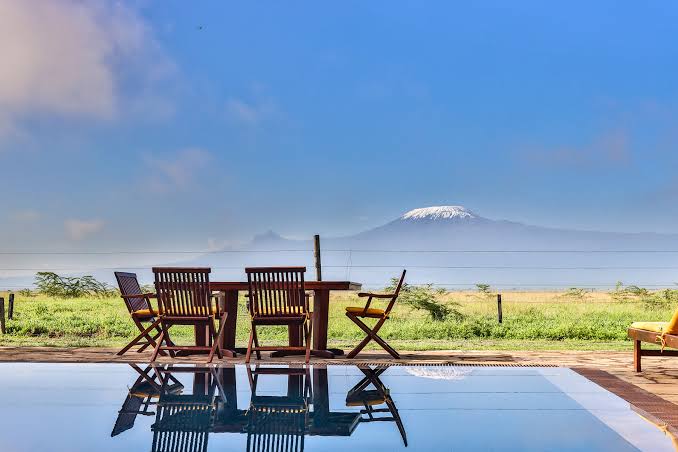
For travellers specifically prioritising the mountain view, it’s worth asking directly which rooms or dining areas at a given property actually face Kilimanjaro, since not every camp within the ecosystem has an unobstructed sightline, and orientation can matter as much as general location.
Activities
Amboseli’s activities are shaped by its terrain: flat, open, and built around the swamps that anchor the wildlife.
Game Drives
Morning and afternoon drives circle the swamp edges where elephant herds, sometimes a hundred strong, gather to drink and wallow. Because the vegetation is low and the terrain flat, the open ground makes for some of the best wildlife photography conditions in Kenya, especially with Kilimanjaro as a backdrop on a clear morning.
Walking at Observation Hill
One of very few spots in Amboseli where visitors can leave their vehicle unescorted, a short, steep footpath with stone steps leads to the summit, giving a genuine overview of the park’s swamps, elephant herds, and Kilimanjaro all at once.
Hot Air Balloon Rides
Balloon flights over Amboseli give an aerial perspective on the park’s swamp system and elephant herds that’s genuinely hard to get any other way, and on a clear morning the chance of a good Kilimanjaro view from altitude is high.
Maasai Cultural Visits
Amboseli sits within traditional Maasai grazing land, and several communities near the park gates welcome visitors to their villages, sharing daily livestock management practices and, depending on the community, the traditional jumping dance.
Birdwatching in the Swamps
The permanent wetlands support around 370 recorded bird species, including kingfishers, herons, egrets and pelicans, with early morning at the swamp edges the most productive time for both activity and light.
Visiting Kimana Sanctuary
A community-run wildlife sanctuary bordering the park’s eastern boundary offers an alternative game-viewing area with lower visitor density than the national park itself, a worthwhile half-day addition for travellers with the time.
Attractions
Two features define Amboseli above everything else, with several smaller draws rounding out the park.
The Elephant Herds
Amboseli is one of the best-studied elephant populations in the world, and among the best places anywhere to see them at close range in large family groups, with decades of ongoing research allowing guides to point out specific matriarchs by name.
Mount Kilimanjaro
At 5,895 metres, Kilimanjaro is Africa’s tallest peak, and although it sits across the border in Tanzania, Amboseli offers the classic unobstructed view of its snow-capped summit. Early morning, often just after sunrise, is by far the most reliable window for a clear view before afternoon cloud builds.
Observation Hill
Genuinely the best single vantage point in the park, taking in the swamp system, wildlife concentrations and mountain views in one sweep.
The Swamps of Enkongo Narok and Olokenya
These permanent wetlands are the ecological engine of the park, staying lush through the dry season and reliably drawing concentrations of elephant, buffalo, hippo, and water birds.
The Open Plains and Dried Lake Bed
The dry, cracked bed of the former Lake Amboseli gives the park its distinctive stark, wide-open scenery, the visual signature recognisable from countless safari photographs.
Wildlife Highlights
The Big Tuskers
Amboseli is one of the last strongholds of ‘big tuskers’, older bull elephants whose tusks reach almost to the ground, a genetic trait carefully protected here after decades of research by the Amboseli Trust for Elephants.
Maasai Giraffe
Distinguished by their jagged, vine-leaf-shaped spot pattern, Maasai giraffe browse the park’s acacia woodland in good numbers, often seen silhouetted against Kilimanjaro in early morning light.
Lions of the Swamp Edge
Amboseli’s lions have adapted to hunt around the swamp margins rather than open plains, with individual prides tracked and studied for decades.
Fun Facts
- Amboseli means ‘salty, dusty place’ in the Maasai language, a nod to the dry lake bed that dominates much of the park’s terrain.
- The park’s underground water system keeps its swamps green even in the depths of the dry season, drawing wildlife from far outside the park boundary.
- Researchers have individually identified and tracked thousands of elephants in Amboseli since the 1970s, making it one of the longest-running elephant studies in the world.
- On the clearest mornings, Kilimanjaro’s summit is visible from well over 100 kilometres away.
- At just 392 square kilometres, Amboseli is one of Kenya’s smallest national parks, yet its elephant research programme is among the most cited in the world’s conservation literature.
Frequently Asked Questions
When is the best time to photograph Kilimanjaro from Amboseli?
Early morning, typically within an hour or two of sunrise, before afternoon cloud cover builds around the mountain’s summit.
How many days should I spend at Amboseli?
Two to three days is generally sufficient given the park’s compact size, enough time for both morning and evening game drives and a visit to Observation Hill.
Is Amboseli good for elephant viewing specifically?
Yes, genuinely one of the best places in Africa for elephant viewing, with large family herds and some of the longest-running elephant research anywhere in the world.
Can I combine Amboseli with Tsavo?
Yes, both sit in southern Kenya and are often combined within a single itinerary, particularly for travellers continuing on toward the coast.
Is walking permitted at Amboseli?
Only at Observation Hill within the park itself. Walking safaris and night drives are available in the surrounding conservancies and group ranches, but not within the core national park.